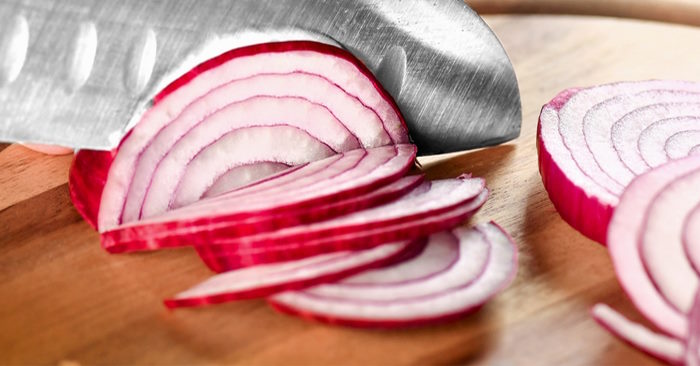
The sulfuric compound released when cutting onions—propanethial S-oxide—often irritates the eyes, causing tears. Now, scientists have discovered a simple method to minimize this discomfort.
Researchers from Cornell University in the United States conducted experiments revealing that sharper knives and slower cutting significantly reduce the release of volatile compounds from onions during preparation. This keeps eyes drier and kitchen surfaces cleaner.
Biomechanical engineer Zixuan Wu and his team employed a miniature cutting machine, high-resolution cameras, and sensors to meticulously track liquid droplets released during onion cutting. They analyzed how droplet characteristics varied with knife sharpness, cutting speed, and force.
Physicist Sunghwan Jung noted, “We found that the speed of water-containing vapor release was significantly higher than the knife’s cutting speed.”
Each onion layer has an outer and inner skin. When punctured, two effects occur: an immediate mist spray, followed by slower seepage of liquid through the layers.
The researchers discovered that dull knives produce significantly more droplets, which are expelled faster. Greater force is required to cut through the layers with a dull blade, increasing pressure within the onion’s liquid. Faster, harder cuts with dull knives propel droplets further.
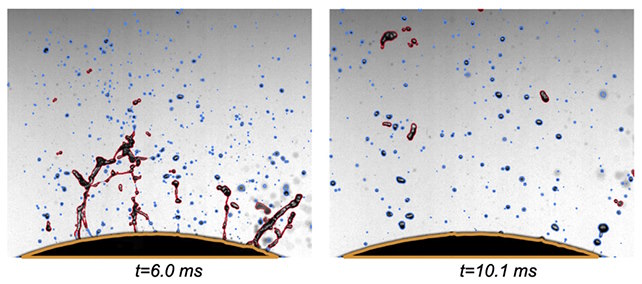
Observations showed initial droplet speeds reaching up to 40 meters per second—144 km/h. These high-velocity droplets pose the greatest risk to the eyes.
The study also debunked the common belief that chilling onions reduces mist and tearing. Initial onion temperature appears to make no significant difference; if anything, chilling may worsen the effect.
“These observations are supported by theoretical models that accurately capture independently measured fracture forces,” the researchers wrote in their published paper.
Onions have been kitchen staples for approximately 5,000 years, with Shakespeare even referencing their tear-inducing properties in *Antony and Cleopatra*.
Now, we better understand how the aerosol particles causing tears are generated and released, and how to mitigate them. The team found that using sharp knives and gentle cuts keeps the mist below eye level.
This discovery also has food safety implications. If bacteria are present, cutting methods influence their spread. As seen in last year’s E. coli outbreak at McDonald’s in the U.S., pathogens can quickly spread through contaminated onions.
“Suppose you have pathogens on the outer layer of the onion,” Jung explained. “Cutting can encapsulate these pathogens in droplets, facilitating their spread.“
The study was published in *PNAS*.